

Strongest legal weed: the honest answer, and our ranking

By the Golden High teamUpdated 5 October 20268 min read
Buying guide
Looking for the strongest legal weed? Honestly, a CBD that gets you high doesn't exist: pure CBD has no high, whatever its percentage. If you want a clear effect, the CBD percentage isn't what matters; the molecule and its strength are. We explain why, which products to steer clear of, and we rank our whole Delta-P range, from the mildest to the strongest, with the rules for dosing it right.

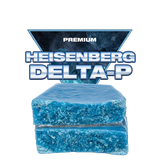
Heisenberg Delta-P 60 %
Our highest-strength resin: looks like a bluish Piatella, with blueberry notes. For experienced users only.
From7,90 €View product →
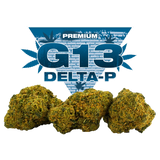
G-13 Delta-P 30 %
Dense bud covered in trichomes, with an earthy, woody and peppery profile. The top of our flower range.
From6,90 €View product →The short answer
The strongest CBD that gets you high? None, and that's normal.
We'd rather tell you straight than sell you a dream: a CBD flower or resin at 40%, 60% or 90% won't get you high. CBD, or cannabidiol, doesn't work like THC. It can help you unwind, but it doesn't produce the psychoactive effect of cannabis. Pushing up the percentage doesn't change its nature.
When a "CBD" product has a real effect, it contains something else: THC above the tolerated limit, a banned semi-synthetic molecule, or another cannabinoid. So the whole question is what, and at what strength.
What doesn't matter
The CBD percentage. A flower with 30% CBD is still a CBD flower: more flavour, maybe more relaxation, but no high.
What matters
The active molecule and its strength, displayed and lab-tested. That's what separates a mild product from an intense one.
What the sources say
Pure CBD, no high at all.
This isn't a sales pitch: it's the position of health authorities and the courts. References at the bottom of the page.
WHO · expert committee, 2018
The WHO Expert Committee on Drug Dependence concluded that pure cannabidiol has no psychoactive properties and shows no potential for abuse or dependence. It recommended not placing it under international control.
French Council of State · 29 December 2022
France's highest administrative court overturned the ban on selling raw hemp flowers and leaves under 0.30% THC, ruling it disproportionate. It noted that cannabidiol "has no psychotropic properties", while pointing out that the 0.30% limit is not a safety threshold.
French decree of 30 December 2021
It sets the framework for hemp products in France: delta-9-THC content must not exceed 0.30%.
In other words, a product sold as "CBD that gets you high" is either marketing, or a product that contains something other than what its label says. That second category is the one you need to learn to spot.
The traps
"Strong CBD" products to avoid at all costs.
Since 2022, part of the market has made up for CBD's lack of effect with semi-synthetic molecules, marketed as legal alternatives. Several of them have since been classified as controlled drugs.
- HHC, HHC-O, HHC-P: classified as controlled drugs in France since 13 June 2023 (ANSM decision).
- THCP, H4-CBD, H2-CBD, HHCPO, THCA: classified as controlled drugs in France since 3 June 2024. THCP is covered in detail in THCP: effects, risks and legal status.
- Products with no strength or lab test: if the label doesn't say what's inside, you don't know what you're smoking.
- "100% legal guaranteed" promises: the rules change fast; be wary of anyone promising what nobody can guarantee.
Key takeaway: a product sold as "CBD that gets you high" that actually contains HHC, THCP or H4-CBD is a controlled drug in France, whatever the packaging says.
What really has an effect
Delta-P, a stronger effect than CBD.
This is where we own the commercial side of this article. At Golden High, we've taken a different route: Delta-P is the name of our range, based on CBDX, a cannabinoid with a clearly stronger effect than CBD. Every product stays under 0.3% THC and is lab-tested batch by batch, with the strength shown on each product page.
The molecule, how it works and its framework are explained on our Delta-P page. And if you're still torn between the two worlds, we compared them in Delta-P or classic CBD: which one to choose.
The ranking
The strongest legal weed in our range, from mildest to strongest.
Here's our whole Delta-P range ranked by strength, as shown on our product pages. It's the simplest way to know what you're getting into.
| Level | Flowers | Resins | Who it's for |
|---|---|---|---|
| 10 to 15% | Gelato 10 %, Amnesia 12 %, Royal Cheese 15 % | — | First try, moving from CBD to Delta-P |
| 20 to 25% | Moon Rock 20 %, Zkittlez 20 %, Bruce Banner 25 %, Cali Mochi 25 % | Lemon Mousseux (under 20%) | Clear effect, for those who know |
| 30 to 40% | G-13 30 % | Jaune Mousseux, Marocain, Double Peach and White Piatella 30 %, Olivette 35 %, 3X Filtré 40 % | Regular Delta-P users |
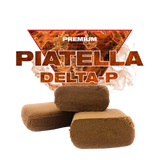
| 50 to 60% | — | Piatella 50 %, Heisenberg 60 % | Very experienced users |
Two products stand out at the top. On the resin side, Heisenberg Delta-P 60 %, our highest strength. On the flower side, G-13 Delta-P 30 %. All our resins are in the Delta-P hash collection.
Our refillable pods contain a liquid concentrated at 90% Delta-P. That figure can't be compared with a flower's or a resin's: the amount you inhale per puff isn't the same.
Beyond the percentage
The percentage isn't the whole intensity.
Two products at the same strength can leave very different memories. The percentage is a starting point, not a promise. Several factors weigh just as much.
- The format: a resin packs more active material per gram than a flower; a pod is dosed puff by puff.
- The amount: a crumb of 60% resin can hit harder than a whole joint of 12% flower.
- Your tolerance: a regular user and a beginner won't experience the same product the same way.
- The context: tiredness, an empty stomach, alcohol: everything changes how you feel the effect.
- The strain: the aroma profile and a genetic's reputation shape the experience, without guaranteeing anything.
To learn how to assess a product before you light it, read from chill to cosmic: reading a product's intensity. And if you want our selection of the most popular flowers, our top 5 Delta-P weed is made for you.
Dosing right
The stronger it is, the lower you start.
Start low
One or two puffs for a flower, an amount the size of a grain of rice for a concentrated resin.
Wait
At least 15 minutes when inhaling before taking more. Let the effect settle in before you judge it.
Step up gradually
Only move to the next level in the table once the previous one no longer surprises you.
The non-negotiable rules:
- Adults only.
- Never before driving.
- No mixing with alcohol when trying a strong product.
- Not for pregnant or breastfeeding women.
Your questions
What people ask us about strong CBD.
What is the strongest legal weed?
Not a CBD: pure CBD has no high, whatever its strength. A clear effect comes from another molecule. In our Delta-P range, legal in France under 0.3% THC, the most intense product is Heisenberg resin at 60%.
Can CBD get you high?
No. The WHO concluded in 2018 that pure CBD has no psychoactive properties, and France's Council of State acknowledged in 2022 that it has no psychotropic effect.
What is the most potent CBD flower?
A CBD flower doesn't start getting you high at a higher percentage. In our Delta-P range, the flower with the highest strength is G-13, at 30%.
What is the strongest CBD resin?
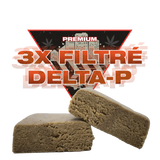
In Delta-P, our strongest resin is Heisenberg at 60%, followed by Piatella at 50% and 3X Filtré at 40%. For experienced users, in very small amounts.
Why do some CBD products get you high?
Because they contain something other than CBD: THC above 0.3%, or semi-synthetic molecules such as HHC or THCP, now classified as controlled drugs in France.
Is the strongest CBD legal?
In France, a hemp product is tolerated if it contains less than 0.3% THC. Our Delta-P products meet that limit and are lab-tested batch by batch. Check the rules where you live.
What strength should I start with?
Between 10 and 15% if you're coming from CBD: Gelato, Amnesia or Royal Cheese. Wait at least 15 minutes before taking more, and never drive afterwards.
Sources
The references cited in this article.
- WHO. WHO Expert Committee on Drug Dependence review of cannabis.
- French Council of State, decision no. 444887 of 29 December 2022 (Légifrance). Council of State, 1st and 4th chambers combined, 29/12/2022, 444887 (in French).
- Légifrance. Decree of 30 December 2021 implementing article R. 5132-86 of the French Public Health Code (in French).
- ANSM (2023). The ANSM adds hexahydrocannabinol (HHC) and two of its derivatives to the list of controlled drugs (in French).
- ANSM (2024). The ANSM adds new cannabinoids to the list of controlled drugs (in French).