

Dry sift hash and static dry sift: dry sifting explained

By the Golden High teamUpdated 6 October 20268 min read
Resins & extractions
Dry sift hash is hash made by sifting dried plant material through fine screens, and static hash is that same dry sift refined with static electricity, which pulls the trichome heads away from the leftover plant matter. The result: a lighter, cleaner powder than a standard sift. Here's how micron screens work, what “x1”, “x2” and “x3” actually mean, how to spot a good dry sift, and what all this has to do with 3X Filtré.

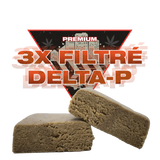
3X Filtré Delta-P 40 %
A resin filtered three times, soft and even, with an earthy, intense profile. For fans of pure resins.
From7,90 €View product →
Pack Shit, 3 resins
Piatella, Black Hasch and 3X Filtré together: three textures to compare the styles side by side.
From35,90 €View product →The definition
Dry sift hash and static hash: hash sifted dry.
Dry sift is the oldest and simplest way to make hash. You shake dried plant material over a screen: the trichomes, those tiny resin glands that carry the cannabinoids and terpenes, break off and fall through the mesh, while the leaves and stems stay on top.
The powder you collect, also called kief or pollen, can be used as it is or pressed, often with a little heat, into a block of hash. No water, no solvent: it's a purely mechanical method.
The screens
It all comes down to the micron.
A screen is defined by the size of its mesh, measured in microns (µm, thousandths of a millimetre). The finer the mesh, the more it holds back. Makers run the powder through finer and finer screens, for example 160, then 120, then 73 µm, to isolate the fraction they want.
Why those sizes? Because the mature trichome heads, the richest ones, sit mostly in the 73 to 120 µm fractions. Above that, the powder carries more plant debris; below it, mostly small immature trichomes and dust.
160 µm and up
First pass: holds back the big debris and lets the trichomes through.
120 to 90 µm
The most sought-after zone: mature trichome heads, very little plant matter.
73 µm
Medium-sized trichomes, still good quality.
45 µm and below
Small immature trichomes and fine dust: a lower grade.
The modern story of dry sifting runs through Mila Jansen, who launched the Pollinator in 1994: a rotating drum, inspired by a tumble dryer, that knocks the trichomes through a mesh. The same inventor later brought out the Ice-O-Lator bags for ice-water extraction, which we cover in our article on Frozen, the cold-extracted hash.
What the sources say
Static dry sift: electricity working for your hash.
Even when it's well sifted, a dry sift still holds fine plant particles that slip through the mesh. Static is there to get rid of them. It isn't a new extraction but a refining step applied to a dry sift that's already been sifted. References at the bottom of the page.
Journal of Cannabis Research · 2025
Researchers from Dalhousie University (Canada) and a filtration company measured the electrical properties of trichomes and plant matter: the plant matter carries a positive charge, the trichomes a negative one. That difference makes it possible to separate them with an electric field.
The craft method
You charge a surface by rubbing it (plastic film, roller, plate) and pass it over the spread-out powder: one fraction is attracted, the other stays put. Some makers work cold, around 0 °C, to make the trichomes more brittle and the separation more selective (Norddampf).
The number of passes
Production guides consider 2 to 4 successive static passes on the same powder to be optimal (Norddampf). Each pass cleans it up, but also removes a bit of material.
The melt rating
Like ice-water hash, dry sift is judged by how it melts: a “full melt” melts almost completely, a “half melt” leaves a little residue.
In practice, static hash is simply a cleaner dry sift: lighter in colour, with less plant matter and a taste truer to the plant's terpenes. It doesn't change what the product is: made with THC, it's hash like any other.
The grades
x1, x2, x3: what these grades mean.
On labels and in shops you'll see “Dry Sift x1”, “x2” or “x3”. In practice, these refer to the number of passes through the screen or the refining step: the higher the number, the more the powder has been purified. But be careful: no official standard governs them, and every maker uses its own scale.
| x1 | x2 | x3 | |
|---|---|---|---|
| Passes | One sift | Two sifts | Three sifts or more |
| Plant matter | Still present | Reduced | Minimal |
| Typical colour | Darker, greenish | In between | Lighter, blond |
| Texture | Sandy, dry | Sandy, slightly greasy | Fine powder, sticky when warm |
| Yield | Highest | Medium | Lowest |
This table sets out the general logic. A badly made x3 can be less clean than a carefully made x2: your eyes and nose remain the best judges, along with a lab-tested potency.
How to spot it
A good dry sift shows.
- A light colour. Blond, golden or cream for the best grades; a green-brown tone gives away more plant matter.
- A sandy texture. Loose, the powder runs through your fingers; pressed, it turns soft with warmth.
- No visible debris. Under a magnifying glass you should see tiny beads, not bits of leaf.
- A strong smell. A fresh dry sift smells strong as soon as you open it; a faint smell points to an old or poorly stored product.
- A green, dusty powder sold as “static”: chances are it was never refined.
- “x3” with no other information: the grade is no substitute for the potency or a lab test.
Against other hash
Dry sift, Frozen, Piatella: the differences.
| Dry sift / static | Frozen | Piatella | |
|---|---|---|---|
| Starting material | Dried plant | Fresh frozen plant | High-quality Frozen |
| Method | Dry sifting (+ static electricity) | Ice water + filter bags | Cold curing over several weeks |
| Water / solvent | Neither | Water, no solvent | Neither |
| Texture | Sandy or pressed powder | Sticky to sandy depending on grade | Creamy, buttery |
Piatella is where the “ice water” route ends up, as we explain in Piatella, the creamy hash. Static, for its part, is where the “dry” route ends up.
At Golden High
And where does 3X Filtré fit in?
The name of our 3X Filtré is a direct nod to this grading logic: a resin filtered three times to keep only what matters. We've gone through the process in detail in what is 3X Filtré.
Let's be precise: a THC “dry sift x3” is still a controlled drug in France. Our 3X Filtré Delta-P 40 % takes the style of a triple-filtered resin into a Delta-P version: a CBDX-based range, under 0.3 % THC, lab-tested batch by batch. To see where its potency sits in the range, read the Delta-P resin guide or browse the Delta-P hash collection.
Crumble
A filtered resin is easy to work with: warm it slightly between your fingers and crumble it finely.
Start small
At 40 %, an amount the size of a grain of rice is enough to start with. Wait before taking more.
Store
Airtight container, away from light and heat, to keep its aromas.
Remember: adults only. Start low, leave plenty of time between two uses, and never get behind the wheel after consuming.
Your questions
What people ask us about dry sift.
What is static hash?
A dry sift, meaning hash sifted dry, refined with static electricity: a surface charged by rubbing attracts one fraction of the powder and separates the trichomes from the plant matter.
What is dry sift hash?
Hash made by sifting dried plant material through fine mesh screens. The trichomes fall through, the debris stays behind. No solvent and no water are used.
What does x3 dry sift mean?
Usually the number of passes through the screen or the refining step: x3 means a powder purified three times. No official standard defines these grades; every maker has its own scale.
What's the difference between dry sift and static dry sift?
Static isn't a different extraction: it's a refining step applied to a dry sift, using static electricity to remove the remaining plant particles.
What's the difference between dry sift and Frozen?
Dry sift is made dry, from dried plant material; Frozen is extracted with ice water, from fresh frozen plant material. Both are mechanical methods with no solvent.
Which screen should I use for dry sift?
Makers often chain 160, 120 and then 73 micron screens. The most sought-after trichome heads sit in the 73 to 120 µm fractions.
Is static hash legal?
In France, hash with more than 0.3 % THC is a controlled drug, like any hash. Only hemp products under 0.3 % THC are tolerated in France.
Sources
The references cited in this article.
- Journal of Cannabis Research (2025). Electrostatic separator of cannabis trichomes: an innovative approach to extraction.
- Norddampf. Creating a Static Hash: A Simple Guide (Static Tech).
- Lowtemp Plates. What Is the Best Micron for Bubble Hash?.
- Cannactiva. Mila Jansen: God Save the Queen (of Hash).
- Wikipedia. Hashish.
- Légifrance. Order of 30 December 2021 applying article R. 5132-86 of the French Public Health Code (in French).