

THC-free CBD: can you really trust “0% THC” products?
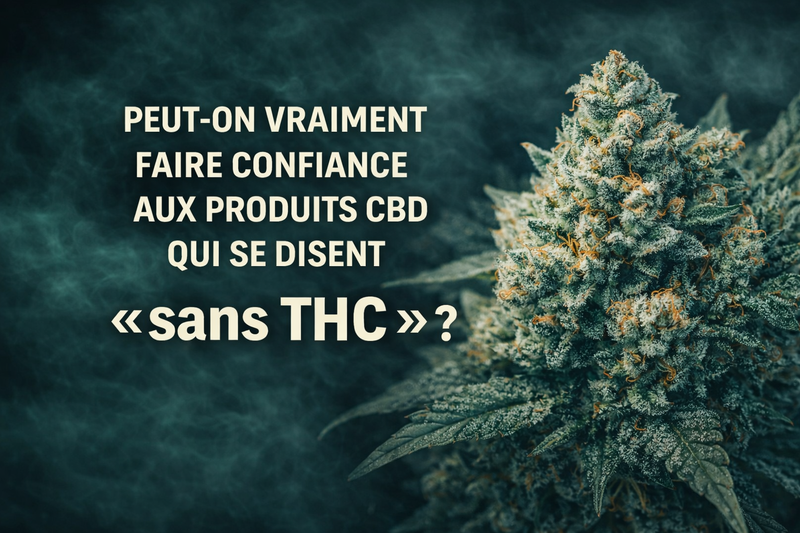
THC-free CBD: can you really trust “0% THC” products?
In 2026, plenty of products proudly carry a “THC-free CBD” or “0% THC” label. For some people, that’s a deal-breaker: no psychoactive effect, no legal grey area, no worrying about a roadside drug test.
On paper, it’s reassuring.
But in practice, can a CBD product really be completely free of THC
? And above all, can you trust that promise?
The answer deserves a bit more nuance than a simple yes or no.
What French law says in 2026
In France, a CBD product can be sold as long as it stays under a strict threshold: less than 0.3% delta-9 THC. At that level, it is regarded as non-psychoactive. In other words, it isn’t expected to get you “high”.
But be careful:
“Below 0.3%” does not mean “absolute zero”.
A product can fully comply with French rules and still contain a measurable trace of THC. It’s an important distinction, because many consumers assume that “compliant” automatically means “THC-free”.
That’s not quite the same thing.
Is 0% THC CBD really possible?
Yes, it’s technically possible. But it depends on the type of extraction used. CBD with genuinely no detectable THC is usually made from:
-
a purified CBD isolate
-
or a broad spectrum extract from which the THC has been removed
In those cases, lab reports often state “THC not detected” (ND) or “0.00%”. This means the level is below the detection limit of the equipment used.
And this is where it gets interesting:
in a lab, nobody talks about absolute zero, only about a limit of detection.
In other words, “0%” means “not detectable with this testing method”.
Why do some products sold as “THC-free” contain traces?
Several scenarios can explain it.
First, the choice of full spectrum. A full spectrum product keeps all the cannabinoids naturally present in the plant, including a small amount of THC, always under the legal threshold in France. That isn’t fraud, it’s a different formulation.
Next, traces can come from the manufacturing process. A poorly controlled extraction or a shared production line can lead to cross-contamination, especially when protocols aren’t rigorous.
Finally, not every shop communicates with the same transparency. The CBD market has become more professional, but standards still vary from one player to the next.
How can you tell whether a product is really THC-free?
The only reliable answer is independent lab testing. A certificate of analysis (COA) should clearly state:
-
the exact THC level
-
the detection limit
-
the full cannabinoid profile
-
the absence of contaminants
In 2026, any serious shop in France should be able to provide these documents easily, ideally right on the product page.
A big “0% THC” splashed across a banner isn’t enough. What counts is the proof.
THC-free CBD and saliva tests: a real issue
The question comes up a lot, especially among drivers and professionals who are subject to testing.
Saliva tests in France look for THC, not CBD. Cannabidiol itself is not a prohibited substance there.
A product with genuinely no detectable THC should not trigger a positive test. A full spectrum product containing legal traces, on the other hand, may carry a theoretical risk with heavy, regular use.
It’s rare, but it isn’t impossible.
For someone who gets tested frequently, a broad spectrum or isolate product is generally the more reassuring option.
Full spectrum, broad spectrum or isolate: which should you choose?
It all depends on what you’re looking for.
Full spectrum keeps all the natural compounds, including a legal trace of THC. It’s often associated with a more complete “entourage” effect.
Broad spectrum removes the THC while keeping the other cannabinoids. It’s an interesting middle ground.
CBD isolate, for its part, contains only pure cannabidiol, with no other molecules.
In France, all three formats can be sold as long as they meet the regulations. The choice mostly comes down to how demanding you are and to your own situation.
Can you trust THC-free CBD products?
Yes, provided you check.
A “THC-free” product can be perfectly well formulated and compliant. But trust should never rest on a marketing promise alone.
It rests on:
-
accessible lab reports
-
clear traceability
-
transparent communication
-
compliance with the French legal framework
In 2026, the CBD market in France is more mature. Consumers are better informed. Serious brands are betting on transparency.
In the end, the problem isn’t the “THC-free” label. The problem is the lack of proof.
In short
Yes, CBD with no detectable THC is possible. No, not all “0%” claims are equal.
The difference isn’t on the label. It’s in the lab reports.
And today, in France, you have the tools to check.
Products compliant with the legislation in force in France (THC < 0.3%). Always consume in moderation.