

What is rosin? How it's made, plus live rosin vs hash rosin

By the Golden High teamUpdated 20 October 20268 min read
Extractions
What is rosin? Rosin is a cannabis concentrate made using nothing but heat and pressure: you squeeze flower, kief or hash between two heated plates and the resin flows out, with no butane, no alcohol, no solvent at all. Popularised in 2015, the technique has become the benchmark for solventless extraction. Here's how it's made, what sets flower rosin, hash rosin and live rosin apart, and what you can actually find in France.

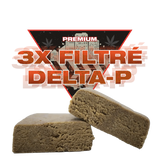
3X Filtré Delta-P 40 %
A Delta-P resin filtered three times, for anyone after a clean texture and a pronounced strength.
From7,90 €View product →
Piatella Delta-P 50 %
A supple resin with the highest strength of the pair, best kept for experienced users who know their dose.
From7,90 €View product →The definition
What is rosin? Heat, pressure and nothing else.
The principle fits in one line: heat and pressure to pull the cannabinoids and terpenes out of plant material, without adding any solvent. The heat softens the resin held in the trichomes, the tiny glands that cover the flowers; the pressure pushes it out. What you collect is a sticky, amber oil that firms up as it cools.
The name is a nod to music: rosin is also the resin violinists rub on their bows. The extract has the same colour and texture.
- Method: hot pressing between two plates, inside a filter bag.
- Starting material: dried flower, kief, hash or fresh frozen flower (for live rosin).
- Solvent: none, which is what puts it in the "solventless" family.
- Texture: anything from runny sap to creamy "badder", depending on the material and resting time.
Where rosin comes from
Born from an accident with a hair straightener.
According to the story published by High Times, the modern technique is credited to Phil "Soilgrown" Salazar, a grower from Pasadena, California. In early 2015, he used a hair straightener to flatten some average-quality hash, pressed too hard, and watched an oil separate from the material. A few days later, he tried the same thing on flowers. It worked.
January 2015
Salazar's first experiments with a straightener, on hash and then on flowers.
February 2015
He shares the technique publicly.
12 March 2015
A demo on the online show Hash Church: the method spreads through the whole solventless extraction community.
After that
The straightener gives way to dedicated presses, manual, pneumatic or hydraulic, with heated plates set to the exact degree.
Rosin didn't invent the solventless concentrate, though: sieved hash and ice-water hash have been around far longer. We traced that story in what is hash.
Types of rosin
Flower rosin, hash rosin, live rosin.
Every rosin is pressed the same way. What changes is the starting material, and with it the taste, the purity and the price.
Flower rosin
Pressed straight from dried, cured flowers. The easiest to make, with a more "earthy" profile. It carries more plant matter along with it.
Hash rosin
Pressed from ice-water hash (bubble hash) or dry-sifted hash. Cleaner, because you're pressing almost nothing but trichome heads.
Live rosin
Hash rosin made from fresh frozen plants, washed in ice water and then pressed. It keeps more terpenes: it's the most sought-after and most expensive version.
Kief or dry sift rosin
Pressed from dry-sifted trichomes. Powdery or sandy starting texture, high yield.
On the starting materials: ice-water hash made from frozen plants is covered in our article on frozen hash, and dry sifting in the one on static hash and dry sift.
The rosin press
Temperature, pressure, yield: the benchmarks.
A rosin press is two heated plates and a clamping system. Manufacturers publish setting ranges that are broadly agreed on: hotter gets you more; cooler preserves the terpenes better. The figures below are press manufacturers' benchmarks, not standards.
| Material | Recommended temperature | Typical yield |
|---|---|---|
| Dried flower | 82 to 104 °C (180-220 °F) | About 15 to 30% of the weight |
| Kief, dry sift | 60 to 93 °C (140-200 °F) | About 40 to 60% |
| Ice-water hash | 60 to 93 °C, often at the low end | Often over 50% |
| Trim and leaves | Same as flower | About 5 to 10% |
The manufacturer The Press Club puts the sweet spot for flower between 93 and 99 °C (200-210 °F). Go higher and the yield climbs, but the aromas thin out. Hence two schools: the cold press, slower and more fragrant, and the hot press, more productive.
What the sources say
Rosin vs BHO: it's all about the solvent.
BHO (butane hash oil), sold as wax, shatter or budder, is extracted with a hydrocarbon, butane or propane, which is then evaporated off. Rosin uses nothing of the kind. The sources below show why that difference matters. References at the bottom of the page.
Weedmaps · concentrates glossary
Rosin is defined as a concentrate obtained through heat and pressure alone. Unlike solvent-based extracts, which rely on hydrocarbons such as butane or propane, solventless methods introduce no chemical solvent.
Journal of Medical Toxicology · 2015
BHO can contain up to 90% THC. At the study's burn centre in Colorado, 29 burn cases linked to making it were admitted between 2008 and August 2014, none before medical cannabis was liberalised.
High Times · 2017
The story of how rosin was born highlights its main appeal: a concentrate you can make without dangerous solvents and with very little equipment.
| Rosin | BHO, wax, shatter | |
|---|---|---|
| Extraction | Heat and pressure | Hydrocarbon solvent (butane, propane) |
| Solvent residue | None, by design | Possible if the purge is done badly |
| Production risk | Burns from touching the plates | Explosions and severe burns (flammable gas) |
| Yield | Lower | Higher |
Is rosin a drug? Legal or not?
Rosin in France: it all comes down to THC.
Rosin isn't a molecule, it's a method. So its status depends on what you press. In France, THC is a controlled drug; hemp products are tolerated below 0.3% THC, under the decree of 30 December 2021. A rosin made from THC-rich cannabis, like the ones sold in North American dispensaries, is therefore a controlled drug in France, however clean its extraction.
Key takeaway: "solventless" doesn't mean "legal", or "mild". A concentrate is still a concentrate: strengths are far higher than in flower, and you manage your dose accordingly. Start with a tiny amount, never before driving, and adults only.
At Golden High, we don't sell anything marketed as rosin. Our range of Delta-P resins is CBDX-based, below 0.3% THC, lab-tested, with the strength shown on every product page. How Delta-P works is explained on our dedicated page.
In the shop
Into rosin? Here's what to look for.
What people love about rosin is the clean taste, the pliable texture and the concentration. Those are exactly the criteria to check on a resin.
Filtration
The more a resin is filtered, the less plant matter it contains. Our 3X Filtré Delta-P is a case in point.
Strength
It should be displayed. For a high strength, the Piatella Delta-P 50 % is best kept for experienced users.
Lab testing
Every batch should be traceable to a lab analysis, with THC below 0.3%.
- Store your resins away from heat and light, in a sealed container: terpenes are volatile.
- Be wary of "rosins" or "extracts" sold online with no strength or lab report: a concentrate without a reliable label could contain anything, synthetic cannabinoids included.
- Don't try butane extraction at home: the Colorado study quoted above shows how badly it can burn you.
To understand filtration inside out, read what 3X filtered means.
Your questions
What people ask us about rosin.
What is rosin?
A cannabis concentrate made by pressing flower, kief or hash between two heated plates. The resin flows out without any solvent being used.
What's the difference between live rosin and hash rosin?
Hash rosin is pressed from hash. Live rosin is a specific kind of hash rosin: the hash is made from fresh frozen plants, which preserves more terpenes.
What temperature should a rosin press run at?
Manufacturers recommend about 82 to 104 °C for flower and 60 to 93 °C for hash and kief. Hotter boosts the yield, cooler preserves the aromas.
Is rosin a drug?
Rosin is an extraction method. If it's made from THC-rich cannabis, it's a controlled drug in France. Only hemp products below 0.3% THC are tolerated there.
What's the difference between rosin and wax?
Wax is usually a BHO, extracted with butane or propane. Rosin is extracted without solvent, using only heat and pressure.
What yield does rosin give?
As a rough guide, press manufacturers quote about 15 to 30% for flower, 40 to 60% for kief and often over 50% for good hash.
Why is it called rosin?
In English, rosin is the resin violinists use on their bows. The extract has the same amber, sticky look.
Sources
The references cited in this article.
- High Times (2017). The Birth of Rosin.
- Weedmaps. The different types of solventless concentrates: rosin, ice water hash, and more.
- The Press Club. Rosin Press Temperature Guide.
- Green Thumb Depot. Rosin Press Yield – Complete Guide.
- Journal of Medical Toxicology (2015). Butane Hash Oil Burns Associated with Marijuana Liberalization in Colorado.
- Légifrance. Decree of 30 December 2021 applying Article R. 5132-86 of the French Public Health Code (in French).
- Larousse. English-French dictionary: rosin.