

What is HHC? Effects, risks and why it's banned in France

By the Golden High teamUpdated 1 October 20269 min read
Novel cannabinoids
If you're wondering what is HHC, here's the short answer: HHC, or hexahydrocannabinol, is a cannabinoid made in a lab through a process called hydrogenation. Sold freely in France in 2022 as flowers, resins and vapes, it was classed as a controlled drug by the ANSM on 13 June 2023. Here's what it really is, what we know about its effects, why it was banned, and what replaced it.

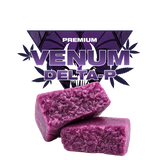
Amnesia Delta-P 12 %
Our most popular flower: a moderate strength to discover Delta-P gently, with a lemony profile.
From4,90 €View product →
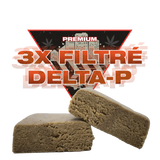
Jaune Mousseux 30 %
The frothy resin that built the shop's reputation: soft, pliable texture and a denser effect.
From7,90 €View product →The definition
What is HHC? A cannabinoid made in a lab.
HHC is a molecule from the cannabinoid family. Tiny traces of it exist in the cannabis plant, but all the HHC that went on sale was semi-synthetic: you start from a hemp extract (in practice, CBD), convert it into THC, then add hydrogen atoms to the molecule. That step, hydrogenation, is where the name comes from: hexa-hydro, six extra hydrogens.
The result looks a lot like THC, the molecule behind the psychoactive effect of cannabis. That's exactly what made it a commercial hit, and exactly what got it banned.
- Full name: hexahydrocannabinol.
- Origin: semi-synthetic, made from hemp-derived CBD.
- Effect: psychoactive, close to that of THC.
- Status in France: a controlled drug since 13 June 2023.
Where HHC comes from
A molecule from 1940, a product of 2022.
The first synthesis of HHC was described in 1940 by the American chemist Roger Adams, who was trying to identify the active compounds in cannabis. For eighty years, the molecule remained a lab curiosity.
It resurfaced in the early 2020s, first in the United States and then in Europe, where the European drugs agency (EUDA, formerly EMCDDA) first spotted it around May 2022. In less than a year, it had been reported in 20 EU Member States, as well as in Norway and Switzerland. Its whole selling point fitted in one sentence: it wasn't on any list of controlled drugs.
9R-HHC
One of the two forms of the molecule. This is the one that binds well to the CB1 receptors in the brain and carries most of the psychoactive effect.
9S-HHC
The mirror-image form, with much weaker affinity for those receptors. Seized products contained both forms in varying ratios, between 1:1 and 2:1.
In practice, this meant two products both sold as "HHC 90%" could have very different effects depending on the ratio of each form. That was one of the big problems with this market.
What the sources say
HHC effects close to THC, and adverse reports.
There are no clinical trials of HHC in humans. What we know comes from lab work, analyses of seized products and reports from French addiction-monitoring centres. Here are the most solid reference points.
EUDA · technical report 2023
The European agency describes an effect comparable to cannabis, and points out that the composition of products on sale was highly variable and often poorly labelled.
ANSM (the French medicines agency) · June 2023
The French agency concluded that the risk of abuse and dependence was equivalent to cannabis, and reported adverse effects: tremors, vomiting, anxiety, bad trips, confusion, dizziness, tachycardia, chest pain and blood pressure spikes.
Pharmacology studies · 2023-2024
Published research confirms that 9R-HHC activates CB1 receptors the way THC does, while 9S-HHC is clearly less active.
ANSM · early 2024
Several hundred poisonings were recorded among people using products containing synthetic or semi-synthetic cannabinoids (HHC, HHC-O, H4-CBD, H2-CBD…). This led to the second wave of bans in June 2024.
In other words: HHC was not a "soft" or "legal" version of THC. It was a psychoactive product, randomly dosed, with very little data behind it. References at the bottom of the page.
Legal or banned?
Banned in France since 13 June 2023.
In France, HHC is now classed as a controlled drug. Producing, selling, possessing and using it are all prohibited in France, just like THC. Here's how it got there.
May 2022
First detections of HHC on the European market. In France, it's sold in shops and online, often marketed as "legal".
12 June 2023
ANSM decision: HHC and two derivatives, HHC-O (acetate) and HHC-P, are added to the list of controlled drugs.
13 June 2023
The ban takes effect: production, sale and use become illegal in France.
3 June 2024
New decision: the ANSM adds cannabinoids with a benzo[c]chromene core, including HHCPO, THCP, THCA, H4-CBD and H2-CBD.
Key takeaway: any product sold in France today as "HHC", "HHC-P" or "HHC-O" is a controlled drug, however it's presented. There is no tolerated HHC level.
The risks
What made this market dangerous.
- Unpredictable dosing. The 9R to 9S ratio changed from one batch to the next, and so did the strength of the effect.
- Manufacturing residues. Synthesis involves solvents and metal catalysts; a poorly purified product can still contain them.
- Unreliable labels. Tests on seized products found molecules other than the ones listed, including far more potent synthetic cannabinoids.
- Documented adverse effects. The ones listed by the ANSM, with emergency visits for racing heart, fainting or panic attacks. In an emergency, call 112, the European emergency number.
That's also why a product's origin and lab testing matter as much as the molecule itself. We cover this in our article on ADB-Pinaca, a synthetic cannabinoid found in products sold as something else.
Up against THC and Delta-P
HHC vs THC: three names, three situations.
| THC | HHC | Delta-P (Golden High) | |
|---|---|---|---|
| Origin | Natural, found in cannabis | Semi-synthetic (hydrogenation) | Range based on CBDX, under 0.3% THC |
| Status in France | Controlled drug (tolerated under 0.3% in hemp) | Controlled drug since 13/06/2023 | Products sold in shops, lab-tested |
| Effect | Psychoactive | Psychoactive, close to THC | Stronger than CBD |
| Traceability | — | Poor, random labelling | Strength shown on every product |
Everything about Delta-P, its molecule and its framework is explained on our dedicated page: the complete Delta-P guide. And if you're after the difference with THC specifically, we've broken it down in Delta-P vs THC: what's the difference.
What now?
What took the place of HHC.
The HHC ban emptied the shelves of a good number of shops. Some fell back on other semi-synthetic molecules, several of which were banned in turn in June 2024 (THCP, H4-CBD, HHCPO). Others, like us, chose products whose strength is displayed and lab-tested.
We told the story of that transition in HHC banned: what replaced it?, and compared the alternatives in Delta-P or CBD: which one to choose.
Check the strength
A serious product shows its cannabinoid content and stays under 0.3% THC.
Ask for the lab report
Every batch should be traceable to a certificate of analysis from an independent lab.
Start low
A moderate strength, a small amount, and time between doses. Never before driving.
Your questions
What people ask us about HHC.
Is HHC legal in France?
No. In France, HHC is classed as a controlled drug by an ANSM decision of 12 June 2023, which took effect on 13 June 2023. Producing, selling, possessing and using it are prohibited.
What is HHC, and is it natural?
HHC is hexahydrocannabinol, and the kind that was on sale wasn't natural. Traces exist in the plant, but commercial HHC was made from CBD, converted and then hydrogenated in a lab.
HHC vs THC: what's the difference?
HHC is a hydrogenated version of THC. Its active form (9R-HHC) acts on the same receptors as THC, with comparable reported effects. Both are controlled drugs in France.
Does HHC show up in a saliva test?
Roadside tests look for THC. Cross-reactions with similar molecules are possible, but data on HHC is limited. The only reliable rule: never drive after using a psychoactive product.
What are HHC-P and HHC-O?
Two HHC derivatives: HHC-P, with a longer chain, and HHC-O, the acetate form. In France, they were classed as controlled drugs at the same time as HHC, on 13 June 2023.
Is Delta-P the same as HHC?
No. Delta-P is the name of our range, based on CBDX, under 0.3% THC. It's neither HHC nor THCP. Everything is explained on our dedicated Delta-P page.
Why was HHC banned in France?
The ANSM found that its risk of abuse and dependence was equivalent to cannabis, that its structure was very close to THC, and it recorded numerous adverse effects among users.
Sources
The references cited in this article.
- ANSM (2023). The ANSM adds hexahydrocannabinol (HHC) and two of its derivatives to the list of controlled drugs (in French).
- ANSM (2024). The ANSM adds new cannabinoids to the list of controlled drugs (in French).
- EMCDDA / EUDA (2023). Hexahydrocannabinol (HHC) and related substances — Technical report.
- ACS Chemical Biology (2023). Studies pertaining to the emerging cannabinoid hexahydrocannabinol (HHC).