

What is THCP? Effects, risks and why France banned it in 2024

By the Golden High teamUpdated 3 October 20269 min read
Novel cannabinoids
What is THCP? THCP, or tetrahydrocannabiphorol, is a cannabinoid identified in 2019 by Italian researchers, and its affinity for the CB1 receptor, measured in the lab, is roughly 33 times that of THC. It reached the European market as flowers, resins and vape liquids, and in France it has been classed as a controlled drug since 3 June 2024 by decision of the ANSM (the French medicines agency). Here's what we know about its effects and risks, and why Delta-P has nothing to do with it.

Moon Rock Delta-P 20 %
Compact coated core, powdery surface, a spicy then lemony profile. A stated level, below 0.3% THC, lab-tested.
From6,90 €View product →
Pack Ultime, 5 products
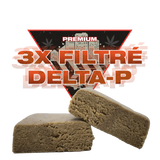
Our most intense products in one box: Moon Rock, G-13, 3X Filtré, Jaune Mousseux and a pod. For connoisseurs only.
From62,90 €View product →The definition
What is THCP? A long-chain THC.
THCP has the same structure as delta-9-THC, the molecule behind the effect of cannabis, with one difference: its “tail”, the chain of carbon atoms attached to the molecule, has seven carbons instead of five. That detail matters. Chemists already knew that synthetic versions of THC with a longer chain were far more active than THC itself.
THCP does exist in the plant, but only in trace amounts. All the THCP that was sold commercially was therefore made in a lab, which puts it, alongside HHC, in the family of so-called “semi-synthetic” cannabinoids.
- Full name: (-)-trans-Δ9-tetrahydrocannabiphorol.
- Identified in: 2019, in an Italian medical cannabis variety.
- What sets it apart: a 7-carbon side chain (5 for THC).
- Status in France: controlled drug since 3 June 2024.
The 2019 discovery
An Italian discovery, in 2019.
At the end of 2019, a team from the University of Modena and Reggio Emilia and the CNR, Italy's national research council, published the identification of a new phytocannabinoid in the journal Scientific Reports. The researchers weren't looking for a potent molecule: they wanted to map the full profile of a medical cannabis variety, FM2, produced by the Military Chemical and Pharmaceutical Institute in Florence.
In that extract, they isolated two unknown molecules with a seven-carbon chain: THCP and its CBD counterpart, CBDP. They confirmed the finding by synthesising the molecule themselves and comparing it with the one found in the plant.
Potency measured in vitro
On the human CB1 receptor, THCP shows an affinity of 1.2 nM, comparable to that of a very potent synthetic agonist, and roughly 33 times higher than THC's (40 nM).
A tiny presence
The researchers put its content at about 29 micrograms per gram in the extract studied, or roughly 0.003%. So there's no way to extract commercial quantities from the plant.
A 33-fold higher affinity in the lab doesn't mean a 33-fold stronger effect in humans. That figure, widely used in marketing, describes how the molecule binds to the receptor, not what you actually feel.
What the sources say
THCP effects: close to THC, at a much lower dose.
There is no clinical trial of THCP in humans. What we know comes from the 2019 animal study, analyses of seized products and medical reports. Here are the most solid reference points, all listed at the bottom of the page.
Scientific Reports · 2019
In mice, THCP produces the four typical cannabinoid effects (reduced activity, analgesia, catalepsy, lower body temperature), in other words THC-like activity, reached at lower doses.
PCN Reports · 2025
US doctors describe the case of a regular THC user with no history of psychosis who was hospitalised after a single 8 mg dose of THCP: 48 hours of psychotic symptoms. The authors conclude that even seasoned THC users can react badly to this molecule.
Drug Testing and Analysis · 2025
An analysis of 80 “semi-synthetic” products seized in Germany found long-chain derivatives, including Δ9-THCP, and THC above 0.3% in about a quarter of the samples.
ANSM · May 2024
The French agency justified the classification with reports of serious effects received by its addiction-monitoring centres, effects more intense than those of cannabis, and a potential for dependence.
Put simply: the reported effects of THCP are of the same kind as THC's, but the gap between “a little” and “far too much” seems much narrower. And on an unregulated market, nobody really knew what dose they were taking.
The risks
Why THCP worried the authorities.
- Potency that's hard to dose. A few milligrams are enough: a badly dosed product can produce an effect far beyond what the user expects.
- A lab-made molecule. The THCP on sale was synthesised, with all the risk of residues and impurities that comes with uncontrolled manufacturing.
- Mixed products. Labs that analysed vapes and other commercial products found cocktails in them: THC isomers, HHC and THCP combined in a single product.
- Almost no human data. No studies on how long the effects last, on interactions or on dependence: only case reports.
It's the same story as HHC a year earlier. We covered it in detail in What is HHC and why it's banned.
Legal or banned?
In France, THCP has been banned since 3 June 2024.
THCP is now classed as a controlled drug in France. Producing, selling, possessing and using it are prohibited there, just like THC and HHC. It wasn't targeted on its own: the ANSM listed a whole family of molecules in one go.
December 2019
The identification of THCP is published in Scientific Reports.
13 June 2023
HHC, HHC-O and HHC-P become controlled drugs in France. Other semi-synthetic molecules, including THCP, are not yet listed.
22 May 2024
ANSM decision: cannabinoids with a benzo[c]chromene core are listed, including THCP, HHCPO, THCA, H4-CBD and H2-CBD, along with several synthetic cannabinoids.
3 June 2024
Entry into force, after an amendment that excludes traces naturally present in hemp products.
Key takeaway: any product sold in France today as “THCP”, “THC-P” or “THCP 10%” is a controlled drug. No level of THCP is tolerated.
THCP, THC, Delta-P
THCP vs THC: what sets them apart.
| THC | THCP | Delta-P (Golden High) | |
|---|---|---|---|
| Side chain | 5 carbons | 7 carbons | — |
| CB1 affinity (in vitro) | Ki ≈ 40 nM | Ki ≈ 1.2 nM | — |
| In the plant | Main molecule | Traces (≈ 29 µg/g) | CBDX-based range |
| Status in France | Controlled drug (tolerated below 0.3% in hemp) | Controlled drug since 3 June 2024 | Products below 0.3% THC, lab-tested |
| Traceability | — | Often mixed products | Level shown on every product |
The smaller the Ki value, the more strongly the molecule binds to the receptor. That's what earned THCP its “super THC” reputation. For the difference between THC and our range, we wrote a dedicated article: Delta-P vs THC: what's the difference.
A common mix-up
No, Delta-P is not THCP.
The mix-up is everywhere: because they share a “P”, lots of sites present Delta-P as a new name for THCP. That's wrong. Delta-P is the name of our range, based on CBDX, below 0.3% THC and lab-tested batch by batch. No Golden High product contains THCP.
Everything is explained, molecule included, on our Delta-P page and in Delta-P: what it is, effects and legal status. The story of the shift from HHC and THCP to what came next is told in HHC banned: what replaced it.
Read the label
If a seller presents their “Delta-P” as THCP, it's either a mistake or an illegal product. Walk away.
Pick a level
Our flowers range from 10 to 30%. For a clear-cut effect, the Moon Rock 20% is a good benchmark. The whole range is in the Delta-P flowers collection.
Start low
One or two puffs, then wait before having more. Adults only, and never before driving. If you feel unwell, call 112, the European emergency number.
Your questions
What people ask us about THCP.
Is THCP legal in the UK or in France?
In France, no: THCP is classed as a controlled drug by an ANSM decision of 22 May 2024, in force since 3 June 2024, and producing, selling, possessing and using it are prohibited. This article describes the situation in France; THCP's status varies from country to country, so check the current rules where you live, UK included.
What is THCP?
Tetrahydrocannabiphorol, a cannabinoid identified in 2019 by Italian researchers. It looks like THC, but with a seven-carbon side chain instead of five, which gives it a much higher affinity for the CB1 receptor.
What are the effects of THCP?
The reported effects are of the same kind as THC's, but reached at much lower doses. There is no clinical trial in humans; the data come from animal studies and medical reports.
Is THCP dangerous?
The authorities consider it risky: the ANSM noted serious effects in users and a potential for dependence, and a case of a 48-hour psychotic episode after a single 8 mg dose was published in 2025.
Is THCP stronger than THC?
In the lab, its affinity for the CB1 receptor is about 33 times higher than THC's. That doesn't mean a 33 times stronger effect, but a molecule that is active at very small doses, and therefore hard to dose.
Is THCP natural?
It exists in the plant, but only in traces: about 29 micrograms per gram in the variety studied. The THCP on the market was made in a lab.
Is Delta-P the same as THCP?
No. Delta-P is the name of the Golden High range, based on CBDX, below 0.3% THC and lab-tested. None of our products contain THCP.
Sources
The references cited in this article.
- ANSM (2024). The ANSM adds new cannabinoids to the list of controlled drugs (in French).
- ANSM (2023). The ANSM adds hexahydrocannabinol (HHC) and two of its derivatives to the list of controlled drugs (in French).
- Scientific Reports (2019). A novel phytocannabinoid isolated from Cannabis sativa L. with an in vivo cannabimimetic activity higher than Δ9-tetrahydrocannabinol: Δ9-Tetrahydrocannabiphorol.
- PCN Reports (2025). Psychosis and suicide attempt following a single use of delta-9-tetrahydrocannabiphorol: A case report.
- Drug Testing and Analysis (2025). Characterising a New Cannabis Trend: Extensive Analysis of Semi-Synthetic Cannabinoid-Containing Seizures From Germany.
- Journal of Forensic Sciences (2026). HPLC-UV quantitation of synthetically derived THC, THCP, and HHC isomers in commercial vaping liquids and edibles (2019-2024).