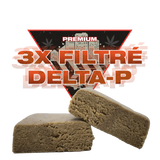


Triple filtered hash (3x filtered): what it is, how to spot it

By the Golden High teamUpdated 9 October 202610 min read
Resins & extractions
Triple filtered hash (also written “3x filtered”, and known in France as “3X Filtré”) is hash whose resin powder has been sifted three times, through finer and finer screens, to remove as much plant matter as possible before pressing. It's neither a molecule nor a strain: it's a filtration grade, and no standard governs it. Here's how it's made, how to spot it, what to make of the “danger” talk, and what our 3X Filtré Delta-P actually is.

3X Filtré Delta-P 40%
Our triple filtered resin: supple, even texture, earthy and intense profile. A high percentage, for people who already know their resins.
From7,90 €View product →
Pack Shit · 3 resins
3X Filtré, Piatella and Black Hasch Delta-P in one pack: three textures to compare side by side.
From35,90 €View product →The definition
Triple filtered hash: hash sifted three times.
Hash is the plant's resin: the trichomes, those tiny glands that carry the cannabinoids and terpenes, separated from the leaves and flowers and then pressed. The “3x” simply tells you how many times that resin has been sorted. A first pass knocks the trichomes loose, and the next two remove everything that isn't trichome: bits of leaf, dust, small stems.
The expected result: a lighter, more even and more concentrated resin. It's a promise of cleanliness, not a recipe or an origin. 3x filtered, triple filtered, three-times filtered, filtered x3, or 3X Filtré in the original French: all these spellings mean the same thing.
If you're new to the subject, start with our article on what hash actually is, which covers the basics.
How it's made
Three passes, finer and finer mesh.
No producer publishes a specification, and the descriptions you can find come mostly from retailers. They do agree on the essentials, though: you work with dried plant material, often chilled because cold makes the trichomes brittle, and you run it through three screens in a row.
1st pass
Wide mesh: the trichomes break off and fall through, while most of the plant matter stays on top.
2nd pass
Medium mesh: the collected powder is sifted again and the most visible debris is removed.
3rd pass
Fine mesh: only the fraction richest in trichome heads, and the lightest in colour, is kept.
Pressing
The powder is pressed, with a little heat, to form a block. No solvent is involved.
Which mesh sizes? One French retailer mentions, for example, screens of around 220, then 160, then 73 microns (µm, thousandths of a millimetre). These figures aren't a rule: every workshop has its own screens. Others get their three grades with ice water, filtering through three bags of decreasing mesh size, on the same principle as bubble hash. So the name “triple filtered” covers two families of process, both of them mechanical.
How the screens work and the part played by static electricity are explained in our article on static hash and dry sift, where we also go through the x1, x2 and x3 grades.
What the sources say
A market name, not a protected label.
Triple filtered hash has never been the subject of a scientific publication under that name. What can be said about it with any confidence comes from the French drugs observatory, from health agencies and, on the technical side, from what sellers themselves admit. References at the bottom of the page.
OFDT · February 2026 report
The French observatory names “3x filtré” explicitly, alongside wax and dry, among the “specific products highly concentrated in THC” picked up by its TREND monitoring scheme on the illicit market. Their price: between €20 and €50 a gram, when ordinary resin sells for around €8.
OFDT · 2024 potency
Cannabis resin seized in France averaged 29.6% THC in 2024, against 15.9% in 2012: an 86% rise in twelve years. That's the level of everyday resin; triple filtered products are ranked above it.
The sellers themselves
One specialist retailer writes that “3x filtré” is sometimes used purely as marketing, with no regulatory definition. In other words, nothing guarantees that a product sold under that name really has been filtered three times.
ANSM · June 2024
The ANSM (the French medicines agency) points out that the composition of cannabinoid-based products sold in shops or online may not match the packaging, with concentrations that are often high and unknown.
The honest conclusion: “3x filtered” describes a method and a look, not a composition. Only a lab analysis tells you what a resin really contains.
How to spot it
Spotting 3x filtered hash: colour, texture, bubble.
Because the name isn't protected, it all comes down to the eye, the fingers and the nose. Here are the pointers hash makers give.
- A golden brown colour. Caramel or brown on the outside, clearly lighter inside when you open the piece up, from golden to beige.
- A supple, greasy texture. It gives under your finger, can be worked without crumbling and gets slightly sticky as it warms up.
- An even look. No green specks, no visible crumbs or fibres: that's exactly what the three filtrations are meant to remove.
- A plant smell. Woody, earthy, spicy, resinous. Unmistakable as soon as you open the bag.
- It bubbles when heated. Bring a flame close without touching it: a clean resin softens, bubbles and melts instead of turning black all at once. That's the old “bubble” test.
- Dry, sandy, brittle: it's a lightly filtered or badly stored hash that's been given a new name.
- Coal black and uniform: a possible sign of overheating during pressing.
- A smell of sweets or chewing gum: a flavouring has been added. A real filtered resin smells of the plant.
- No percentage, no analysis: whatever name is on the label, walk away.
3x filtered, drugs and danger
Is triple filtered hash a dangerous drug?
The answer comes in two parts, because the same name refers to two very different products.
Triple filtered hash with THC
It's hashish, and therefore a narcotic. In France, selling and possessing it are banned, and using it is a criminal offence (article L3421-1 of the French Public Health Code). This is the product the OFDT is talking about when it lists it among products highly concentrated in THC.
The 3X Filtré sold in hemp shops
It's a resin that borrows the triple filtered style, with less than 0.3% THC. What it contains depends entirely on the producer: hence the importance of the stated percentage and the analysis.
Filtration in itself adds nothing dangerous: it's mechanical and solvent-free. The risk comes from what it produces, namely a concentrated product. With THC, the higher the content, the more likely the unwanted effects: Drogues Info Service, the French public drug information service, describes lapses in concentration, slower reflexes from the very first use, and bad trips that can go as far as a panic attack.
A large European study published in The Lancet Psychiatry in 2019, covering 901 patients and 1,237 controls across eleven sites, also linked daily use of high-potency cannabis (10% THC or more) to a risk of psychotic disorder nearly five times higher than in non-users. A resin at 30% or more sits far above that threshold.
A second, lesser-known risk: untested resins. Since 3 June 2024, H4-CBD, THCP and HHCPO have been classed as narcotics in France, and resins carrying nothing more than a style name (“Jaune Mousseux” with H4-CBD or THCP has been seen) were sold with these molecules. Always check the stated molecule and the certificate of analysis, not just the name.
Against other resins
3x filtered, dry sift, static, Piatella: the differences.
These names sit on the same shelves and are easy to mix up. The table sums up what sets them apart.
| 3X Filtré | Dry sift / static | Piatella | |
|---|---|---|---|
| Principle | Three filtrations in a row | Dry sifting, refined with static electricity | Bubble hash cold cured for several weeks |
| Starting material | Dried plant | Dried plant | Fresh frozen plant |
| Texture | Supple, greasy, even | Sandy powder or dry block | Creamy, buttery |
| Colour | Golden brown, light core | Beige-green to blond | Blond, beige, cream |
| What the name tells you | The number of filtrations | The tool (screen, static) | Curing laid flat |
Put simply, a dry sifted 3X Filtré is a dry sift taken to the third grade, then pressed. Piatella, on the other hand, isn't defined by the number of passes but by weeks of curing in the cool, just as Frozen is defined by working with frozen plant material.
At Golden High
Our 3X Filtré: the style, in a Delta-P version.
Let's be clear: the “3x filtré” the OFDT talks about is a THC hash, classed as a narcotic in France. What we sell is a resin that takes up the triple filtered style, its supple texture, its even grain, its earthy profile, in a Delta-P version: a range based on CBDX, with less than 0.3% THC, lab tested. The details are on our page dedicated to Delta-P.
One useful detail: our 3X Filtré Delta-P is labelled 40% Delta-P, and it's that figure, not a name, that should guide your choice.
Supple, even texture, earthy and intense profile, sealed pouch: at 40%, it sits in the upper part of the range, between Jaune Mousseux at 30% and Piatella at 50%. To place each percentage, read the guide to Delta-P resins or browse the Delta-P hash collection.
How to use it
A concentrated resin, so keep the dose small.
Its suppleness makes 3X Filtré easy to work with. Three uses come up again and again: vaporised, with no combustion; crumbled into a mix; or infused, with a fat.
Crumble
Warm it for a few seconds between your fingers, then pull off fine crumbs or roll it out into a thin sausage.
Dose small
At 40%, an amount the size of a grain of rice is enough to start with. Wait before taking more.
Store
Airtight container, somewhere cool, away from light: it keeps its suppleness and its aromas.
Keep in mind: adults only. Start low, leave time between two doses, and never get behind the wheel after using.
If you'd rather avoid combustion, we've covered everything in our guide to vaping hash.
Your questions
What people ask us about 3x filtered hash.
What is triple filtered hash (3x filtered)?
It's hash whose resin has been filtered three times, through finer and finer screens, before being pressed. The aim is to remove plant matter to get a lighter, more even and more concentrated resin.
What does “3x filtered” mean?
That the resin powder has gone through three filtrations in a row. The term isn't defined by any standard: it's a trade name, picked up by sellers, and nothing obliges a producer to prove the three passes.
Is 3x filtered hash a drug?
3x filtered hash with THC is hashish, and therefore a narcotic in France: the OFDT lists it among products highly concentrated in THC. The “3X Filtré” resins sold in hemp shops are different products, with less than 0.3% THC; ours is a Delta-P resin.
Is triple filtered hash dangerous?
Filtration is mechanical and adds nothing. The risk lies in the concentration: with THC, a high content raises the likelihood of unwanted effects. The other risk comes from untested resins, whose real composition is unknown.
How do you spot 3x filtered hash?
Golden brown colour with a lighter core, supple and greasy texture, even look with no green specks, plant smell. When heated, it softens and bubbles instead of turning black. But only a certificate of analysis tells you what's in it.
What's the difference between 3x filtered hash and dry sift?
Dry sift is the method: sifting dry. 3x filtered is a grade: a resin put through the screen three times, then pressed. A dry sifted 3x filtered hash is therefore a dry sift taken to the third pass.
What percentage is Golden High's 3X Filtré?
Our 3X Filtré Delta-P is labelled 40% Delta-P, with THC below 0.3%. It's a resin from the Delta-P range, based on CBDX and lab tested.
Sources
The references cited in this article.
- OFDT (2026). L'offre de stupéfiants en France en 2024 (annual review, in French: THC potency, prices, highly concentrated products).
- ANSM (2024). L'ANSM inscrit de nouveaux cannabinoïdes sur la liste des stupéfiants.
- Drogues Info Service. Le dico des drogues : Cannabis.
- The Lancet Psychiatry (2019). The contribution of cannabis use to variation in the incidence of psychotic disorder across Europe (EU-GEI): a multicentre case-control study.
- Cream High. Hash 3 fois filtré : définition, fabrication et effets expliqués (commercial source, cited for the technique).
- La Plaquette. Hash Jaune Mousseux suisse, c'est quoi ? Fabrication, texture et conseils (commercial source, cited for the heat test).