

Sativa, Indica, Hybrid: Does It Still Mean Anything in 2026?
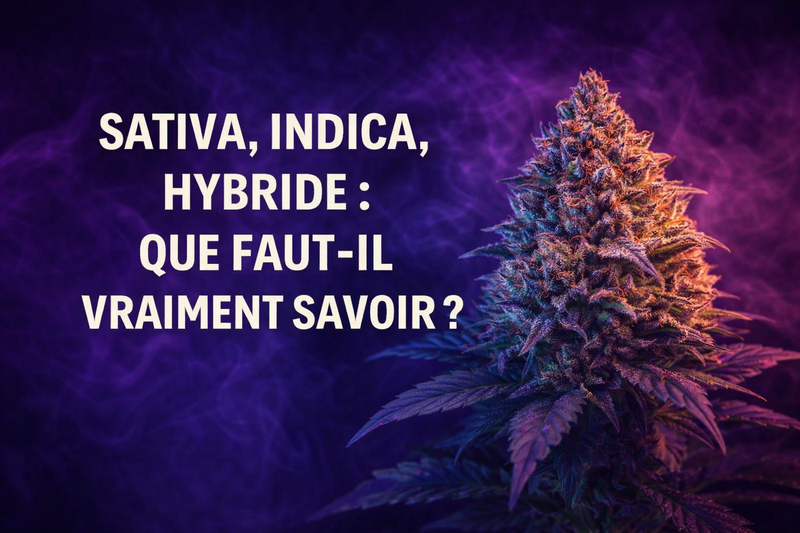
Sativa, Indica, Hybrid: does it still mean anything in 2026?
When you’re looking for a CBD flower, you almost always come across the same words: Sativa, Indica or Hybrid. For years it’s been summed up very simply: Sativa is supposedly more “energising”, Indica more “relaxing”, and Hybrid a balance between the two.
But in 2026, does that distinction really hold up? Not entirely. And understanding why will help you choose far more wisely.
Originally, a simple botanical difference
To begin with, the Sativa / Indica distinction wasn’t about effects but about morphology.
Strains classed as Sativa tended to grow in equatorial regions. They developed tall, slender plants with thin leaves and a longer flowering time. Indicas came from mountainous regions of Central Asia. They stayed more compact, with broad leaves and a denser structure.
Nothing to do, originally, with energy or relaxation. That association came much later, when the industry began simplifying the message to make choosing easier.
Why is Sativa still associated with energy?
Because it’s convenient. Saying “Sativa for daytime” and “Indica for the evening” gives a quick reference point, especially for beginners. The problem is that this framework has become a shortcut.
Today we know that the effect you feel depends far less on the shape of the plant than on its chemical composition. Two flowers classed as Sativa can produce very different sensations, just as two Indicas can have nothing in common in how they feel.
What really shapes your experience
In reality, several things come into play when you use CBD:
-
The actual CBD level
-
The presence of minor cannabinoids such as CBG, CBN or CBC
-
The terpene profile
-
The dose
-
Your personal context (tiredness, time of day, surroundings)
And among all of that, terpenes play a key role.
Terpenes: a strain’s true signature
Terpenes are responsible for lemony, woody, fruity and spicy aromas, but they also influence the way you perceive the overall effect.
A flower rich in limonene (citrus notes) will often be perceived as fresher and livelier. A strain dominated by myrcene (earthy aroma) will give a more enveloping sensation. Pinene brings an impression of clarity, while linalool creates a gentler mood.
That’s why two flowers at 15% CBD can feel totally different. The percentage isn’t everything. The profile is what changes the game.
And where do hybrids fit in?
The truth is that most of today’s strains are hybrids. After decades of crossbreeding, “pure” lines have become rare.
So relying only on the Sativa or Indica label is no longer enough. They’re historical markers, useful for placing a tendency, but not for predicting the experience precisely.
In 2026, serious producers talk more about chemotype and molecular profile than about simple genetic dominance.
How to choose your CBD flower wisely
Rather than only asking whether it’s a Sativa or an Indica, look at:
-
The lab analyses (COAs available)
-
The terpene profile, when it’s stated
-
The growing method (indoor, greenhouse, outdoor)
-
Freshness and visual quality
Then trust your senses. The smell already tells you a lot. Fresh, lemony profiles often fit better into a daytime routine, while woodier or floral aromas go better with a calm mood at the end of the day.
The most important thing is still the dose. Start light, see how you feel, then adjust gradually.
And what about the law in France in 2026?
The framework there remains clear: CBD products must contain less than 0.3% delta-9 THC and cannot claim medical effects. Whether the strain is labelled Sativa, Indica or Hybrid changes nothing about the regulations.
What makes the difference is transparency: accessible analyses, traceability, compliance.
In summary
Sativa, Indica, Hybrid: these terms aren’t wrong, but they’re incomplete. They describe a plant’s botanical history more than the actual experience you’re going to have.
In 2026, the real criterion isn’t the label. It’s the composition.
The secret isn’t only in the CBD level, but in the overall balance between cannabinoids and terpenes. That’s where it all happens.
Products sold in France (THC < 0.3%). Always use in moderation.