

G13 strain: the legend of the “government weed”, myth or fact?

By the Golden High teamUpdated 9 October 20268 min read
Legendary strains
The G13 strain is a cannabis variety with an indica reputation, famous above all for its legend: it was supposedly developed in a US government research programme at the University of Mississippi, then smuggled out by a lab technician. No evidence has ever confirmed this story, and even specialist sites consider it most likely false. Here is what we really know, where the myth comes from, what G13 is supposed to smell like, and what our G-13 Delta-P actually is.

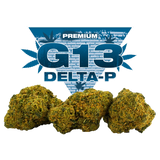
G-13 Delta-P 30 %
Compact flower with earthy, woody and slightly peppery notes: the spirit of G13 in a Delta-P version.
From6,90 €View product →
OG Kush Hydro CBD 25 %
Another cult genetic, grown hydroponically: lemon, wood and an earthy Kush base.
From7,90 €View product →The legend
A weed smuggled out of a secret lab?
The story is almost always told the same way. In the late 1960s, at a facility run by the University of Mississippi, US federal agencies supposedly gathered the best cannabis genetics in the world to study and cross them. The plants were allegedly numbered G1 to G23. The thirteenth, the most remarkable one, was supposedly smuggled out as a cutting by an anonymous technician, before spreading among growers.
It's a great story: a plant “stolen from the government”, bound to be stronger than all the others. That's exactly why you should treat it with caution.
1968
The University of Mississippi becomes the only site authorised to grow cannabis for US federal research. That part is entirely real.
1970s
The period in which the legend places the selection of clones G1 to G23. No public document backs it up.
1984
Australian Nevil Schoenmakers founds one of the very first cannabis seed banks in the Netherlands, The Seed Bank.
1987
G13 appears in his catalogue, presented as an indica cutting “reputedly released” from the Mississippi research programme.
The key word is “reputedly”. From its very first commercial appearance, the government origin was presented as a rumour, not as a fact.
What the sources say
What's true, and what doesn't add up.
The legend rests on a real backdrop. But when you look at what we know about the cannabis grown for US federal research, the picture of a government “super-weed” doesn't hold up well.
PBS NewsHour · 2017
Since 1968, the University of Mississippi farm has been the only site licensed by the DEA to produce cannabis for clinical research in the United States. So the programme really did exist.
Scientific Reports · 2017
Researchers at the University of Colorado compared federal cannabis with cannabis from legal dispensaries: the federal strains contained on average only 27% of the THC found in legal-market products, with far less diversity.
Strain histories
The nurseries and specialist media that have investigated G13 conclude that the government origin has never been verified and is most likely an urban legend. Leafly, one of the largest strain databases, writes that these legends are probably not true.
Wikipedia · Nevil Schoenmakers
The founder of The Seed Bank, nicknamed the “King of Cannabis” by High Times in 1985, was targeted by the federal Operation Green Merchant in 1990. His role as a seed-bank pioneer, on the other hand, is well documented.
The honest conclusion: G13 really does exist as a strain, but its origin remains unknown. The odds that it came from a federal lab are low, and nothing allows anyone to claim it did. References at the bottom of the page.
Its genetics
The G13 strain: an Afghan indica, by reputation.
G13 is described everywhere as a pure indica, often linked to Afghan genetics. Here again, that's what the strain's history says, not a published genetic analysis. According to Leafly, its known offspring include Tangerine Dream and Love Potion.
And what is the “indica” label worth? A study published in Nature Plants in 2021 analysed more than 100 samples: those labelled “sativa” and “indica” were genetically indistinguishable at genome level. The labels were mostly linked to a handful of terpenes. We dug into the subject in sativa, indica, hybrid: do they still mean anything?
Aromas and effects
Earthy, woody, rather laid-back.
On Leafly, users describe G13 with earthy, pine and woody notes, carried by myrcene. As for how it feels, the words that come up most often are relaxation, euphoria and sleepiness, sometimes with a creative touch.
On the nose
Earth, pine, wood. A dark, “old-school” profile, a long way from the sweet or fruity strains of recent years.
The reported feel
Rather laid-back and body-focused according to user reports, which matches the strain's indica image.
A reputation, not a guarantee. The “typical” effects of a strain are aggregated user reports, not measurements. Two flowers sold under the same name can have very different chemical profiles, as a 2022 study of commercial cannabis in the United States showed.
To compare the profiles of the strains we offer, our guide Delta-P flowers: which strain to choose reviews the whole range.
Against the other classics
G13, Amnesia, OG Kush: three profiles.
Lots of searches pair “Amnesia” and “G13”: they are two different strains, often mentioned together because they embody two opposite styles. Here is where our versions stand.
| G-13 Delta-P | Amnesia Delta-P | OG Kush Hydro | |
|---|---|---|---|
| Reputation | Indica, laid-back | Sativa, heady | Kush classic |
| Aromas | Earthy, woody, peppery | Lemony | Lemon, wood, earthy base |
| Stated content | 30% Delta-P | 12% Delta-P | 25% CBD |
| For whom | Fans of strong, full-bodied flowers | Discovering Delta-P | Fans of potent CBD |
Content and aromas taken from our product pages. All our flowers contain less than 0.3% THC and are lab-tested.
OG Kush, for its part, was reportedly first grown in Florida in the early 1990s, according to Leafly. Our OG Kush Hydro is a 25% CBD flower, grown hydroponically.
And at Golden High?
Our G-13: the spirit, not the THC.
Let's be clear: our G-13 is not the THC-rich G13 of legend. It's a Delta-P flower that reproduces the strain's aroma profile, with 30% Delta-P and less than 0.3% THC, lab-tested. THC G13, on the other hand, remains a controlled drug in France.
- Aromas: earthy, woody and slightly peppery notes.
- Look: compact flower, dark green with amber highlights, covered in trichomes.
- Content: 30% Delta-P, THC below 0.3%.
- For whom: experienced users who like full-bodied flowers.
It's one of the most potent flowers in our Delta-P flowers collection, and it features in our selection of the best Delta-P weed of 2026. You can find it on its product page: G-13 Delta-P 30 %.
Start small
At 30%, this is a potent flower: start with a small amount, especially if you're new to Delta-P.
Take your time
Wait until you feel the effect before having more. There's no point in rushing.
Never behind the wheel
No driving after consuming, whatever the product. Adults only.
Your questions
What people ask us about the G13 strain.
What is the G13 strain?
A cannabis strain presented as a pure indica, which appeared commercially in 1987 in The Seed Bank catalogue. It is best known for the legend of its government origin.
Did G13 really come from a US government lab?
Nothing proves it. The University of Mississippi has indeed grown cannabis for federal research since 1968, but no document confirms the existence of clones G1 to G23. Even Leafly considers the legend probably untrue.
Is G13 indica or sativa?
It is presented as an indica, often linked to Afghan genetics. But indica and sativa labels don't faithfully reflect genetics: a 2021 study showed they were indistinguishable at genome level.
What does G13 taste like?
The most common descriptions mention earthy, pine and woody notes, with myrcene as the dominant terpene. Our G-13 Delta-P adds a slightly peppery touch.
What are the effects of G13?
User reports mainly mention relaxation, euphoria and sleepiness. These are effects reported by consumers, not guarantees: they vary with the batch, the person and the amount.
What does G13 stand for?
According to the legend, it would be clone number 13 from a G1 to G23 series. Since the story itself has never been verified, the exact meaning of the name remains unknown.
What's the difference between Amnesia and G13?
They are two distinct strains. Amnesia has a sativa, heady reputation with a lemony profile; G13 has an indica, laid-back reputation with earthy, woody notes.
Is G-13 Delta-P the same as THC G13?
No. It's a 30% Delta-P flower, under 0.3% THC and lab-tested, that reproduces the strain's aroma profile. THC G13 is a controlled drug in France.
Sources
The references cited in this article.
- PBS NewsHour (2017). Scientists say the government's only pot farm has moldy samples — and no federal testing standards.
- Scientific Reports (2017). Compromised external validity: federally produced cannabis does not reflect legal markets.
- Prime Cuts Nursery. G13 Strain – Grow Guide & Genetics (history of the strain and the 1987 catalogue).
- Leafly. G-13 strain and OG Kush strain.
- Wikipedia. Nevil Schoenmakers.
- Nature Plants (2021). Cannabis labelling is associated with genetic variation in terpene synthase genes.
- PLoS One (2022). The phytochemical diversity of commercial Cannabis in the United States.