

What is THC? Meaning, effects, how long it lasts and French law

By the Golden High teamUpdated 12 November 20268 min read
The basics
What is THC, or delta-9-tetrahydrocannabinol? It's the cannabis molecule behind its psychoactive effect: it binds to CB1 receptors in the brain and causes the "high". In France, it's a controlled drug; only hemp products containing less than 0.3% THC are tolerated. Here's what it is, how it works, how long it lasts, how it's detected and how it differs from CBD and Delta-P.

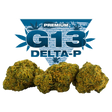
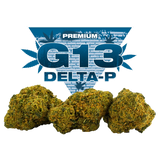
G-13 Delta-P 30 %
A compact flower with earthy, woody, slightly peppery notes: the spirit of G13 in a Delta-P version, under 0.3% THC.
From5,50 €View product →
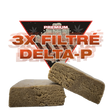
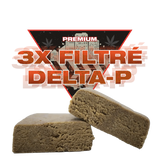
3X Filtré Delta-P 40 %
A triple-filtered resin, soft and even, with an earthy, intense profile. Strength shown on the product page, lab-tested batch.
From6,50 €View product →THC meaning
What is THC? The molecule that gets you high.
THC belongs to the phytocannabinoids, the molecules made by the Cannabis sativa plant. Many are known, but THC is the one that alters perception, mood and coordination. It's produced in the trichomes, the tiny resin glands covering the female flowers.
One important detail: the living plant contains almost no THC as such. It mainly produces THCA, its acid form, which has no psychoactive effect. It's heat (a flame, a vaporiser, cooking) that turns it into THC. We go into detail in What is THCA?
The THC molecule
Tetrahydrocannabinol: a story of receptors.
The name "tetrahydrocannabinol" describes the molecule's chemistry: a cannabinol skeleton carrying four extra hydrogen atoms. "Delta-9" indicates the position of a double bond. Move it one notch and you get delta-8-THC, an isomer of THC.
1964
Yehiel Gaoni and Raphael Mechoulam, in Israel, publish the isolation, structure and partial synthesis of THC, extracted from hashish.
1990
A US team describes the structure of a cannabinoid receptor in Nature and clones it: the CB1 receptor.
Today
We know that THC works by binding to CB1, which is abundant in the brain, which explains its effects on memory, perception and coordination.
CB1 receptors are part of the endocannabinoid system, which your body runs with its own molecules. THC "borrows" that lock. For the molecule's full profile, read what is delta-9.
THC effects
What the research reports.
The effects of THC depend on the dose, how you take it, your tolerance and the setting. The pointers below come from reference publications.
Grotenhermen · Clinical Pharmacokinetics, 2003
Above the psychoactive threshold, THC generally brings a feeling of well-being and relaxation, with heightened everyday perceptions.
Same review · adverse effects
With an overdose, the most significant acute effects are anxiety and panic attacks, with a faster heart rate and changes in blood pressure. Regular use can lead to dependence and a mild withdrawal syndrome.
Mayo Clinic Proceedings · 2017
In urine, THC's main metabolite remains detectable about 3 days after a single use, and more than 30 days in a chronic user.
Conseil d'État · 29 December 2022
Unlike THC, CBD has no psychotropic effect and doesn't cause dependence: that's the ground France's highest administrative court gave for overturning the ban on selling hemp flowers.
These are average reported effects: the same dose can feel pleasant to one person and distressing to another. That's even more true with very strong products. References at the bottom of the page.
How long the effect lasts
Smoked or eaten, two different clocks.
| Smoked or vaped | Eaten (space cake, edible) | |
|---|---|---|
| Onset | From a few seconds to a few minutes | After 30 to 90 minutes |
| Peak | After 15 to 30 minutes | After 2 to 3 hours |
| Duration | Wears off in 2 to 3 hours | Roughly 4 to 12 hours |
| Main trap | Going again too quickly | Thinking "it's not working" and taking more |
Figures from Grotenhermen's review (2003). They vary with the dose, the person and the product.
We've detailed these timings, and what makes them vary, in THC: effects and duration. For urine and saliva tests, we have dedicated articles, listed at the bottom of the page.
Is THC legal in France?
A controlled drug, with a threshold for hemp.
In France, THC is classified as a controlled drug. Cannabis that contains it (weed, resin, oils) is banned. The only exception is hemp: authorised varieties whose THC content stays below 0.3% can be grown and their flowers sold.
30 Dec. 2021
A French order sets the maximum THC content of authorised hemp varieties at 0.3%.
29 Dec. 2022
The Conseil d'État overturns the ban on selling raw hemp flowers and leaves.
3 June 2024
THCA is added to the list of controlled drugs in France, except as traces in hemp under 0.3% total THC.
20 Aug. 2026
The on-the-spot criminal fine for drug use in France goes up to €500 (€400 if paid early, €1,000 if paid late).
Behind the wheel: in France, driving after using THC is punishable by 3 years in prison and a €9,000 fine (5 years and €15,000 with alcohol), plus the loss of half your licence points. Testing looks for the presence of THC, not for intoxication. One rule only: never before driving.
Elsewhere in Europe, THC remains mostly banned. Germany has been the exception since 1 April 2024: its consumer cannabis law (KCanG) allows adults, under conditions, to possess cannabis and grow it at home. None of this applies in France, even for a product bought legally abroad.
THC vs CBD: the difference
THC, CBD, Delta-P: don't mix them up.
| THC | CBD | Delta-P (Golden High) | |
|---|---|---|---|
| What it is | Psychoactive cannabinoid in cannabis | Hemp cannabinoid | Our CBDX-based range |
| Effect | Psychoactive ("high") | No psychotropic effect, according to the Conseil d'État | Stronger than classic CBD |
| THC content | High and variable in cannabis | Under 0.3% in products on sale | Under 0.3%, lab-tested |
| Status in France | Controlled drug | Sale allowed (flowers since 2022) | Products sold in shops, strength shown |
Delta-P isn't THC: it's the name of our range, CBDX-based, under 0.3% THC. We've compared the two in detail in Delta-P vs THC: what's the difference, and the range's framework is explained on our Delta-P page. If you're after the strongest options, our selection of strong products brings together flowers like G-13 Delta-P 30 % and resins like 3X Filtré.
Read the strength
A serious product shows its cannabinoid level and THC under 0.3%.
Check the analysis
Every batch should be linked to a certificate from a third-party lab.
Start low
Small amount, time between doses. Adults only, never before driving.
The risks
What an informed smoker keeps in mind.
- Anxiety and panic. These are the most common acute adverse effects when the dose is too high.
- Your heart. THC speeds up the heart rate; be careful if you have a cardiovascular condition.
- Dependence. Regular use can lead to dependence and withdrawal.
- Synthetic products. E-liquids sold as "cannabis" sometimes contain molecules far stronger than THC, such as PTC.
On that last point, read our article on the PTC drug: it's now one of the main dangers for people who think they're buying cannabis.
Your questions
What people ask us about THC.
What is THC, exactly?
Delta-9-tetrahydrocannabinol, the main psychoactive cannabinoid in cannabis. It acts on CB1 receptors in the brain and causes the "high".
What's the difference between THC and CBD?
THC is psychoactive and classified as a controlled drug. CBD, according to France's Conseil d'État, has no psychotropic effect and doesn't cause dependence; its products are allowed in France if they contain less than 0.3% THC.
Is THC legal in France?
No, it's a controlled drug. Only hemp whose THC content stays below 0.3% is tolerated. Use is punishable by one year in prison and a €3,750 fine, or an on-the-spot fine of €500 since 20 August 2026.
What are the effects of THC?
Publications describe a feeling of well-being and relaxation, with heightened perceptions. When the dose is too high: anxiety, panic attacks and a racing heart.
How long does a THC high last?
Smoked, the effect peaks within 15 to 30 minutes and wears off in 2 to 3 hours. Eaten, it kicks in after 30 to 90 minutes and can last 4 to 12 hours.
How long does THC stay in your body?
In urine, its metabolite is detectable about 3 days after a single use and more than 30 days in a chronic user, according to the Mayo Clinic.
Who discovered THC?
Yehiel Gaoni and Raphael Mechoulam, who published its isolation and structure from hashish in 1964.
Does Delta-P contain THC?
Our Delta-P products contain less than 0.3% THC, with lab-tested levels. Delta-P isn't THC: it's our CBDX-based range.
Sources
The references cited in this article.
- Gaoni Y., Mechoulam R. (1964). Isolation, Structure, and Partial Synthesis of an Active Constituent of Hashish, Journal of the American Chemical Society.
- Matsuda L.A. et al. (1990). Structure of a cannabinoid receptor and functional expression of the cloned cDNA, Nature.
- Grotenhermen F. (2003). Pharmacokinetics and pharmacodynamics of cannabinoids, Clinical Pharmacokinetics.
- Mayo Clinic Proceedings (2017). Clinical Interpretation of Urine Drug Tests: What Clinicians Need to Know About Urine Drug Screens.
- Conseil d'État (2022). CBD: order banning the sale of cannabis flowers and leaves without narcotic properties annulled (in French); Légifrance, order of 30 December 2021 (in French).
- ANSM (2024). The ANSM adds new cannabinoids to the list of controlled drugs (in French).
- Légifrance. French Public Health Code, Article L3421-1; French Highway Code, Article L235-1; German Federal Ministry of Justice, KCanG.
Keep reading